Media Asset Management for Companies
-
8 minutes
8 minutes
Order is half of life – our Media Asset Management
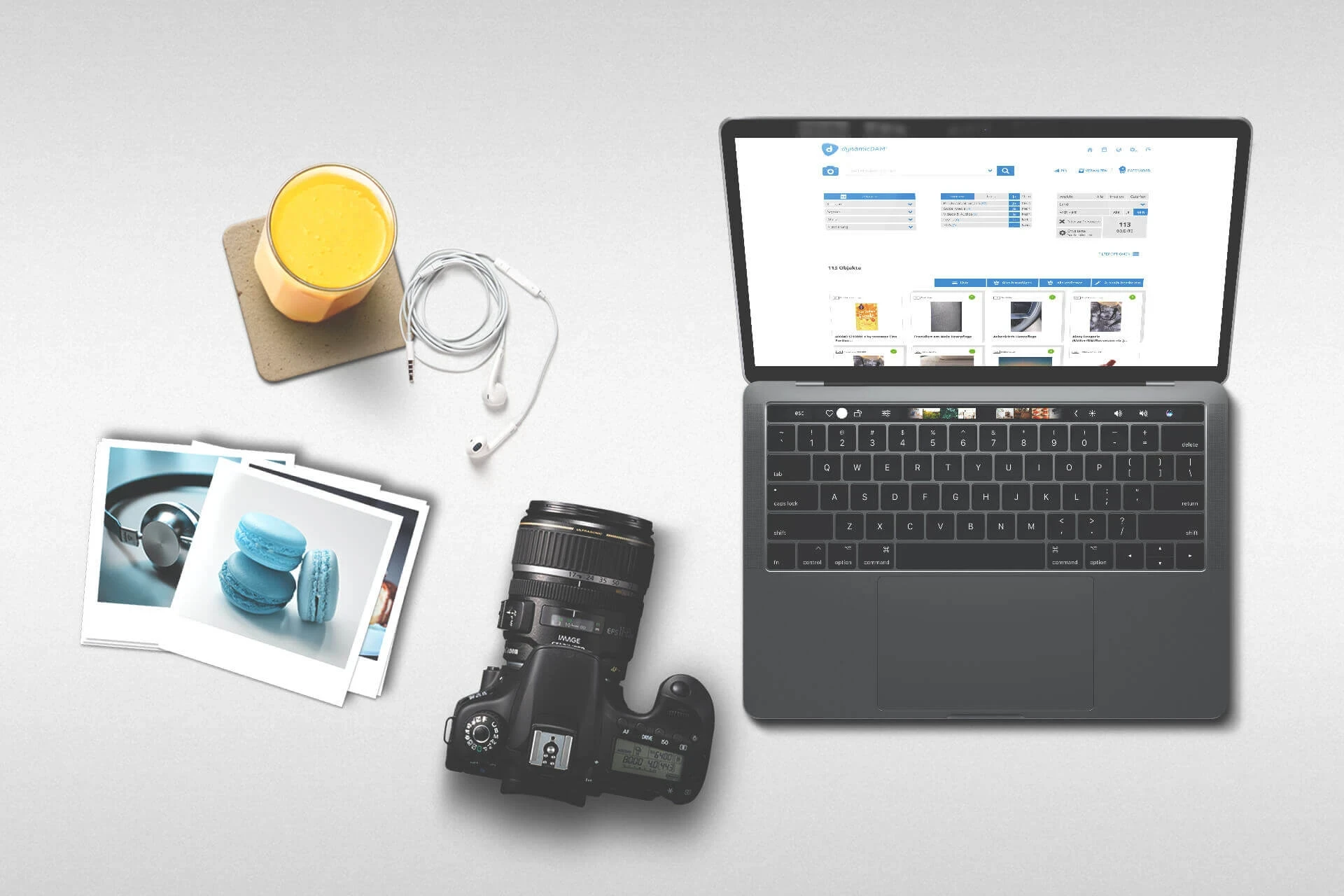
A media asset management system (MAM system) helps you centrally manage your company's media object data and distribute it wherever you want. dynamicDAM® represents a significant step toward greater efficiency in daily operations.
Media Asset Management – the underestimated work
Digital Asset Management (DAM), Media Asset Management (MAM), or simply put, the image database, is not a new phenomenon in the content management sector. Even in the past, there were various systems whose core task was image management, video management, or document management. Starting with desktop applications that had to be installed on one's own computer, the systems migrated to the web. Good systems today are all web-enabled.
Focus on features, unfortunately not on core tasks …
Systems of this type are still compared based on the individual features they offer. Excel lists are sent out, usually predefined by one vendor, and alternatives are evaluated based on whether they also have all of that. Then price comes into play and everything seems clear – the decision is then made based on who has the most to offer in terms of quantity and costs the least for it.
Unfortunately, what was predetermined keeps happening again and again. Out of 100 features, 95 are not used at all, let alone needed; no one thought about data quality, and equivalent assets are uploaded two or three times without end. On top of that, no one understands the system anymore, and anyone is allowed to adjust anything and everything anyway.
Managing the chaos …
Actually, such a system is introduced to provide a solution, not another problem. That is why, for us, intensive professional guidance on the structure and organization of media assets is just as important as a comprehensive explanation of data formats. A lot of educational work is required here in order to work efficiently and in a structured manner right from the start.
Content and purpose of the DAM
Why do I actually need the DAM system? It sounds strange, but requirements often only emerge once the general decision for a DAM has been made. Departments recognize advantages, others only then become aware of it, etc. At this point, it is crucial to stay alert, keep track of the overarching goals, and compare every requirement and feature request to see whether, with a little imagination, it can already be fulfilled with built-in tools.
In addition, the core objective is to distribute ideal data to partners, retailers, sales reps, agencies, customers, and of course your own employees. This already requires a fundamental rethink. Saving logos, images, and texts on the desktop and only using/updating them there is the death of any centralized storage.
Concept, organization, and storage in the Media Asset Management system
A key foundation is structured storage. Many people are used to storing files in folder structures. This is simply because they know it from their computers. Whether Mac or Windows, files are stored in folders. However, this has decisive disadvantages for a DAM. If an image is in one folder, it cannot be in another folder at the same time, but this is precisely a core requirement, as relational storage is mandatory to clearly assign data to multiple structures without creating duplicates.
You wouldn't believe how many DAM systems I have seen where this alone caused massive chaos. Data in a DAM system must be subject to flexible assignment via filters, tagging, types, etc., through which it can also be found. This solves this problem very elegantly. Online and offline data – what was 300 dpi again? A DAM system, and thus the data contained within it, must generally be usable for online and offline use. An identical image is stored only once in the highest possible resolution and is automatically generated by the system in other qualities, sizes, and formats. We call these download formats, including consideration of color profiles, color space conversion, etc. Thus, GS1-compatible formats are just as possible as, for example, 300 dpi jpgs with clipping paths. But png formats with transparencies and smaller pixel sizes are also possible at any time. (You can find more on the subject of image data resolution in our corresponding article.)
Maintaining separate formats for online and offline is simply unnecessary. Only when the image/video is different in terms of content is it also a different asset.
Data formats – a mystery for marketing managers
What is a jpg, what is a png? What can a gif do? Why is there psd? And how did vector formats work again? The old world wasn't so bad sometimes; back then, far more decision-makers knew what those were. Today, unfortunately, that is very rare.
You have to know data formats, all their pros and cons, and their capabilities. Only then can a DAM system leverage its advantages in an increasingly digitized world in the future. Only in this way can misunderstandings be avoided.
A good approach is to establish guidelines for image/video and document formats right from the start. These then apply not only to an MAM system. Only what meets these standards gets in; what does not must be improved. This keeps the system "clean" and data quality increases enormously. We create the fact sheets for such specifications, and our customers are glad to have them, as they provide a reliable basis for excellent data quality. This is especially essential when multiple agencies are frequently supplying assets.
Conclusion: The Single Point of Information
A DAM system, ideally linked with a PIM system (dynamicPIM®), creates an outstanding foundation for today's data requirements. In addition, time-to-market is significantly reduced and products can be published faster in brick-and-mortar retail or eCommerce.
The prerequisite is that the data quality is top-notch. A feature list won't help here; only a good, clean, and structured approach will. Clear rules and a reliable system that enables high availability.
We experience every day that well-structured data—whether product information, media assets, SEO optimization, texts, etc.—is a key competitive advantage. Those who have it are ahead; those who don't struggle to keep up.